

Environmental compliance testing checks and documents that your facility’s air, pressure, filtration, containment, and monitoring meet required standards. These tests are often part of regulatory and quality programs. When audits or questions arise, your records provide the proof that controls are in place.
This guide explains what compliance testing is, where it applies, the main standards, common tests, when to test, and what documentation auditors look for.
What Is Environmental Compliance Testing?
Simply put, environmental compliance testing is a way to check if an environment, system, or process meets required rules or standards, with results that are documented. In general, compliance testing means making sure a product, system, or process meets legal, regulatory, industry, or internal standards.
“Compliance” vs “conformance” vs “certification”
These terms are often used as if they mean the same thing, but they actually have different meanings in practice:
- Compliance: Meeting a requirement that applies to you (law, regulation, policy, contract).
- Conformance: Meeting a published standard/specification (often voluntary unless adopted by a regulator or contract).
- Certification: A formal attestation, often by a qualified third party, that you meet a standard/criteria (typically issued as a signed report/certificate package).
Here’s a simple way to remember: testing gives you evidence, compliance is your status, and certification is the official confirmation.
Why Environmental Compliance Testing Matters
It’s hard to see if environmental controls are working. Testing makes them measurable and easier to prove.
- Safety: Verifies containment and exposure controls are working.
- Quality: Helps prevent contamination-related failures.
- Liability: Records show what was verified, when, how and what was done if something failed.
- Inspection readiness: Auditors expect clear, traceable reports and follow-up, not just assumptions.
If controls slip, the costs later, like audit findings, downtime, fixes, and more testing, are often higher than the cost of the test itself.
Common Areas Where Compliance Testing Is Required
Keep the scope broad. These concepts apply to many types of facilities:
- Controlled environments and cleanrooms: Cleanrooms rely on air cleanliness, airflow patterns, and pressure control. For compliance testing, ISO 14644 classifies cleanrooms based on the concentration of airborne particles.
- Pharmacy sterile compounding environments: USP <797> covers sterile compounding environments and includes expectations for facility and equipment certification/recertification and environmental monitoring.
- Biosafety cabinets and containment devices: Containment devices, like biosafety cabinets, are tested to make sure they protect people, products, and the environment. NSF’s NSF/ANSI 49 standard covers the main design, construction, and performance requirements for these devices.
- Indoor air quality and exposure checks: In areas outside controlled rooms, compliance may involve checking ventilation, testing indoor air quality, or assessing exposure, especially if chemicals, particles, or biohazards are present.
Compliance Testing Standards and Frameworks to Know
You don’t need to know every detaiL, just have a clear map of the standards that apply.
- USP <797> (sterile compounding)
- USP <797> materials commonly reference USP 797 compliance testing and certification/recertification of classified areas and primary engineering controls at least every 6 months, plus testing after changes or issues.
- USP <800> (hazardous drugs handling)
- USP <800> addresses the safe handling of hazardous drugs and emphasizes the use of engineering controls, such as primary and secondary containment, to reduce exposure risk. Facilities often turn these into specific requirements for rooms, equipment, and workflows.
- ISO 14644 (cleanrooms)
- ISO 14644-1 defines cleanroom classification by particle concentration.
- ISO 14644-2 addresses testing and monitoring to demonstrate continued compliance over time.
- NSF/ANSI 49 (biosafety cabinets)
- NSF/ANSI 49 is widely used for Class II biosafety cabinetry design/performance expectations and NSF/ANSI 49 biosafety cabinet certification programs.
Standards Map: What Each One Governs
Think of the major standards as covering different “layers” of environmental control:
- ISO 14644: Air cleanliness classification and continued compliance (non-viable particles; verification testing and monitoring programs).
- USP <797>: Sterile compounding quality expectations (facility/PEC certification cadence, environmental monitoring and operational practices).
- USP <800>: Hazardous drug exposure protection (containment engineering controls and safe handling systems).
- NSF/ANSI 49: Biosafety cabinet performance and certification framework (design/performance requirements and field certification concepts).
Many facilities fall under more than one framework. For example, a controlled room might be ISO-classified and also used for sterile compounding. Your testing plan should clearly list all requirements and show how each one is checked.
The Compliance Testing Process (Step by Step)
A good process is easy to repeat and ready for audits:
- Define scope + applicable standards
Rooms, devices, utilities and the acceptance criteria for each test. - Pre-assessment walk-through
Confirm operating state (at rest vs operational), check obvious issues and identify changes since last certification. - Testing plan + acceptance criteria
Methods, sampling locations, environmental conditions and pass/fail thresholds. - On-site testing
Execute the plan, record raw data and document deviations. - Corrective actions
Fix failures (balancing, repairs, seal/filter replacement, setpoint changes), then document what changed. - Retest + final report/certificate package
Confirm corrective action effectiveness and issue the final documentation set. - Ongoing monitoring schedule
Monitoring helps detect drift early; ISO 14644-2 explicitly addresses proving continued compliance via testing/monitoring.
Typical Tests Performed (Examples by Category)
Here are some common examples. Keep in mind, methods and criteria can change depending on the standard and your facility’s design.
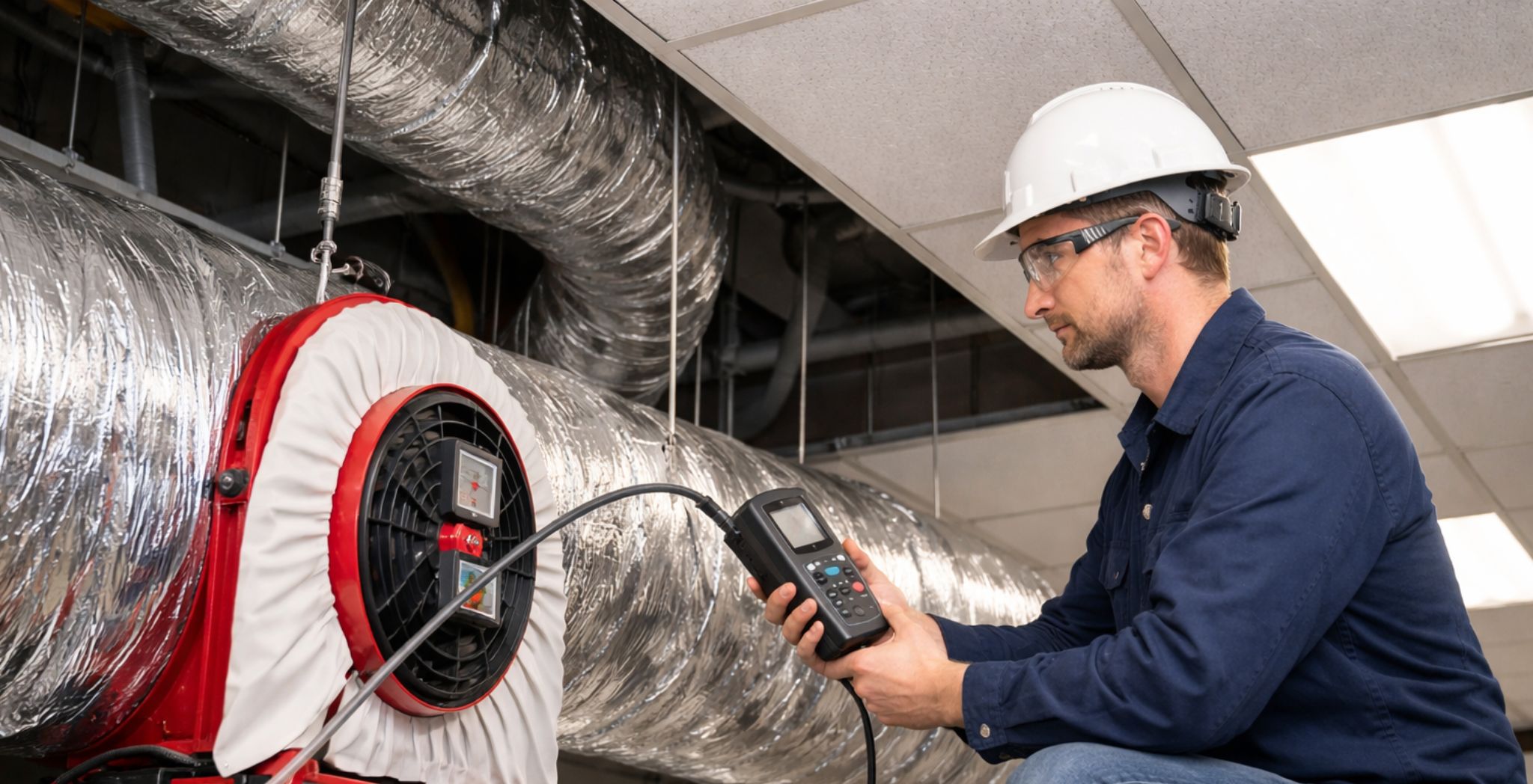
- Airflow velocity/volume and smoke visualization
-
- What it shows: Air delivery/exhaust performance and airflow patterns.
- Why it matters: Even if total airflow looks good, the way air moves can still cause turbulence or bring contaminants into important areas.
- Pressure differentials
-
- What it shows: Directional airflow room-to-room (clean-to-less-clean or negative pressure for containment).
- Why it matters: If pressure changes, it can reverse airflow and reduce control.
- Particle counts (cleanroom classification)
-
- What it shows: Air cleanliness class based on measured particle concentrations and ISO limits.
- HEPA filter integrity/leak testing
-
- What it shows: Whether filters and seals are intact (no bypass).
- Why it matters: Even small leaks can make high-efficiency filters less effective.
Viable air and surface sampling (environmental monitoring)
Many programs use microbial sampling as part of environmental monitoring. ASHP’s toolkit suggests starting with baseline sampling, then doing surface sampling every quarter and viable air sampling every six months, with a focus on good documentation and regular review.
Containment device performance checks (biosafety cabinet context)
Biosafety cabinet checks usually involve measuring airflow speed, checking for HEPA filter leaks, and observing smoke patterns. NSF’s accreditation materials list these as key skills for certifiers.
How Often Should Compliance Testing Be Done?
Testing schedules depend on risk, standards, and how stable your systems are. Most programs use two main approaches: retesting after certain events and regular recertification.
Trigger-based retesting
Retest after events likely to affect performance, such as:
- relocation or reconfiguration,
- HEPA filter replacement,
- major maintenance/repairs,
- renovations or nearby construction,
- accidents/abnormal events,
- extended shutdowns.
For example, it’s common to test biosafety cabinets after major maintenance, replacing HEPA filters, moving the cabinet, or after a long shutdown.
Periodic recertification (example)
USP <797>-related materials commonly reference certification/recertification at least every 6 months for classified areas and primary engineering controls (plus testing after changes).
Always follow the main requirements and your risk assessment. If you see problems in your data, test more often. If your system is stable and you have good monitoring, you might be able to test less often, as long as you document your reasons.
Documentation That Makes or Breaks an Audit
Audits rely on evidence. Keep records that clearly show what was done. Good certification testing and documentation make this much easier.
Test reports (minimum expectations) Include:
- scope and locations,
- standards/methods used,
- room/device state during testing,
- instrument IDs and calibration status,
- results + acceptance criteria,
- pass/fail decisions,
- deviations and how they were handled,
- signatures/dates and (if applicable) certification statements.
Calibration, corrective action and change control
- Calibration certificates (current at time of test)
- Corrective action records (what failed, what changed, retest outcome)
- Change control notes (what changed since the last test and why)
Environmental monitoring logs and trend reviews
If you do environmental monitoring, keep your sampling plans, raw results, investigations, and regular trend reviews. ASHP’s toolkit recommends saving baseline documents and lab reports, and reviewing results as part of your ongoing program.
Preparing for a Compliance Test (Pre-Test Checklist)
Facility readiness
- Check whether you’ll be testing the facility at rest or while it’s operating, and make sure schedules match.
- Complete routine cleaning per SOP before test day.
- Ensure access to rooms, ceilings, diffusers, devices and mechanical areas.
- Make sure people and doors are used the same way as planned for the test conditions.
Equipment readiness
- Close out planned maintenance.
- Gather service records (filters, repairs, setpoint changes).
- Make sure devices are set up and connected correctly, and that they are clearly labeled.
Staff readiness
- Make SOPs, logs and prior reports available.
- Choose someone who can answer questions about what has changed since the last test.
- Avoid making unplanned changes during testing, such as switching modes, shutting down equipment, or having unexpected people in the area.
Common Compliance Testing Mistakes ( and How to Avoid Them)
- Testing in the wrong conditions: Decide ahead of time if you’re testing at rest or during operation, and write it down.
- Missing baseline records: Keep all past reports and environmental monitoring baselines in one place so you can track trends.
- Scheduling a retest before fixing the main problem: Make sure you have a written corrective action plan before you retest.
- Ignoring small changes in the facility: Treat changes to seals, doors, HVAC, or layout as reasons to review, and sometimes retest.
- Weak reports: If your reports are missing methods, acceptance criteria, calibration details, or how you handled problems, audits will be more difficult.
Quick Reference Table: Testing Type → What It Proves → Evidence Kept
| Testing type | What it proves | Typical evidence kept |
| Particle counts (ISO concept) | Air cleanliness class based on particle concentration | Raw counts, locations, room state, pass/fail vs class |
| Airflow velocity/volume | Adequate supply/return or device flow | Data sheets, instrument IDs, calculations |
| Smoke visualization | Directionality, turbulence, containment behavior | Photos/video notes, written observations, deviations |
| Differential pressure | Directional airflow between spaces | Pressure logs, setpoints alarm limits, trends |
| HEPA integrity/leak test | Filters/seals not bypassing air | Scan results, leak locations, repairs, retest outcomes |
| Viable sampling (air/surface) | Microbial control + trend signals | Lab reports, site maps, investigations, reviews |
| BSC performance checks | Cabinet protection markers | Velocity results, smoke pattern notes, leak scan results |
FAQs
Q. What is environmental compliance testing?
It’s the process of verifying, with a defined method and documented results, that an environment/system/process meets applicable requirements.
Q. What’s the difference between compliance testing and certification?
Testing produces evidence and a pass/fail decision; certification is the formal attestation (often third-party) that the evidence meets a standard/criteria.
Q. Which standards apply to cleanrooms and how is compliance verified?
ISO 14644-1 defines particle-based classification and ISO 14644-2 focuses on testing/monitoring for continued compliance. Verification commonly includes particle counts plus supporting airflow/pressure checks and documented monitoring.
Q. How often should cleanrooms be recertified under USP <797> guidance discussions?
Common references in USP <797> materials and summaries cite recertification at least every 6 months, with additional testing after changes.
Q. What documentation should I keep for audits?
Test reports, calibration certificates, corrective action + retest records, EM logs and trend reviews and change control notes.
Q. When do I need re-testing?
After events likely to affect performance, maintenance, relocation, HEPA replacement, renovations accidents and extended shutdowns.
Conclusion
Environmental compliance testing works best when you treat it as a system: find the right standards, test in real conditions, keep clear records, fix problems, and watch for changes over time. When done well, it boosts safety and quality and makes inspections much less stressful.
Need help understanding which standards apply to your facility? Talk to a qualified certification professional.


Leave A Comment