

Hazardous waste disposal is not just a logistical necessity; it is a fundamental pillar of workplace safety, environmental stewardship, and legal compliance.
Whether you run a manufacturing plant, a research laboratory, or a healthcare facility, understanding how to handle, store, and neutralize hazardous materials is essential for your bottom line and the well-being of the community.
In this blog, we will explore the intricacies of hazardous waste management, the legal requirements businesses must follow, and the best practices that ensure your facility remains safe and compliant.
What Is Hazardous Waste Disposal?
At its core, hazardous waste disposal is the systematic process of identifying, collecting, transporting, and treating waste materials that pose a potential threat to public health or the environment. Unlike standard office trash or recyclables, hazardous waste possesses properties that make it dangerous—it might be flammable, corrosive, reactive, or toxic.
The goal of disposal is to render these materials harmless. This is achieved through various methods, including chemical neutralization, incineration at high temperatures, or secure sequestration in specially engineered landfills. For businesses, this process is highly regulated and requires a detailed “cradle-to-grave” tracking system to ensure that waste is accounted for from the moment it is generated until its final destruction.
Types of Hazardous Waste in Commercial and Industrial Facilities
Hazardous waste isn’t limited to glowing green liquids in barrels. It comes in many forms, often hiding in plain sight. Most regulatory bodies, such as the EPA in the United States, categorize these wastes into four main groups:
- Listed Wastes: Wastes specifically named on government lists (such as the F-list for industrial processes or the K-list for specific manufacturing sectors).
- Characteristic Wastes: Wastes that exhibit specific traits:
- Ignitability: Can catch fire easily (e.g., solvents).
- Corrosivity: Can burn through metal or skin (e.g., battery acid).
- Reactivity: Unstable under normal conditions (e.g., pressurized cylinders).
- Toxicity: Harmful if swallowed or absorbed (e.g., lead or mercury).
- Universal Wastes: Common items like batteries, pesticides, and mercury-containing equipment.
- Mixed Wastes: Materials containing both hazardous and radioactive components.
Why Proper Hazardous Waste Disposal Is Critical for Health and Safety
The stakes for improper hazardous waste management are incredibly high. From a human perspective, exposure to mismanaged chemicals can lead to immediate injuries like chemical burns and respiratory distress, or long-term health issues like cancer and organ damage.
From an environmental standpoint, a single leak can contaminate local groundwater, devastate soil fertility, and kill local wildlife. Beyond the physical risks, there are massive financial risks. Regulatory agencies have the power to levy six-figure fines for non-compliance, and the reputational damage from an environmental disaster can take decades to repair. Proper disposal acts as an insurance policy for your facility’s future.
Common Hazardous Waste Disposal Mistakes Businesses Make
Even well-intentioned facilities often fall into traps that lead to compliance issues. One of the most frequent errors involves hazardous waste handling specifically, the improper labeling of containers. If a drum is not clearly marked with its contents and the date it began accumulating, it becomes a “mystery waste,” which is significantly more expensive and dangerous to process.
Another common mistake is “dilution as a solution.” Some businesses attempt to mix hazardous liquids with water or non-hazardous waste to lower the concentration. Not only is this illegal in many jurisdictions, but it also increases the total volume of waste that must be treated, driving up costs. Finally, many facilities fail to conduct regular employee training, leading to accidental spills during routine transfers.
Hazardous Waste Disposal Process: From Identification to Final Treatment
Effective disposal follows a rigid, step-by-step pipeline:
- Identification: Determining if a waste is hazardous through testing or “generator knowledge.”
- Accumulation: Storing the waste in compatible containers (e.g., not putting acid in a metal drum that will corrode).
- Chemical waste disposal prep: This involves segregating chemicals that could react violently if they touched. For instance, oxidizers must be kept far away from flammable solvents to prevent explosions during transport.
- Transportation: Using licensed transporters who use manifest systems to track the waste’s journey.
- Treatment and Disposal: The waste reaches a TSD (Treatment, Storage, and Disposal) facility where it is either recycled, neutralized, or permanently stored.
Compliance Requirements for Hazardous Waste Disposal
Staying on the right side of the law requires a deep understanding of hazardous waste compliance. In the U.S., the Resource Conservation and Recovery Act (RCRA) dictates the rules. Facilities are classified based on how much waste they generate per month (Very Small, Small, or Large Quantity Generators).
Each category has different rules regarding how long waste can stay on-site and what kind of paperwork is required. Key compliance pillars include maintaining a detailed “Uniform Hazardous Waste Manifest,” having a robust emergency contingency plan, and ensuring all staff are certified in handling procedures. Missing even a minor record-keeping step can result in a “Notice of Violation” during an inspection.
Hazardous Waste Disposal in Healthcare, Manufacturing, and Laboratories
Different industries face unique challenges when it comes to dangerous materials. In clinical settings, medical hazardous waste disposal focuses on “red bag” waste, sharps, and chemotherapy agents. These materials require specialized sterilization or incineration to prevent the spread of infectious diseases.
In manufacturing, the focus shifts to industrial hazardous waste disposal, dealing with bulk quantities of oils, sludges, and heavy metals. Meanwhile, laboratories often deal with “lab packs” small quantities of many different chemicals. Each of these sectors must tailor their waste stream management to their specific chemical profile, ensuring that high-volume industrial runoff isn’t treated the same way as a single bottle of laboratory reagent.
The Role of Environmental Waste Management
A modern facility should look beyond just “getting rid of stuff” and embrace environmental waste management. This philosophy prioritizes the “Waste Hierarchy”: Reduce, Reuse, Recycle, and then Dispose. By auditing your processes, you might find that a certain solvent can be distilled and reused on-site, or that a hazardous raw material can be replaced with a non-toxic alternative. This “green chemistry” approach not only helps the planet but significantly reduces the volume of waste you have to pay to haul away.
Implementing Safe Waste Disposal Practices
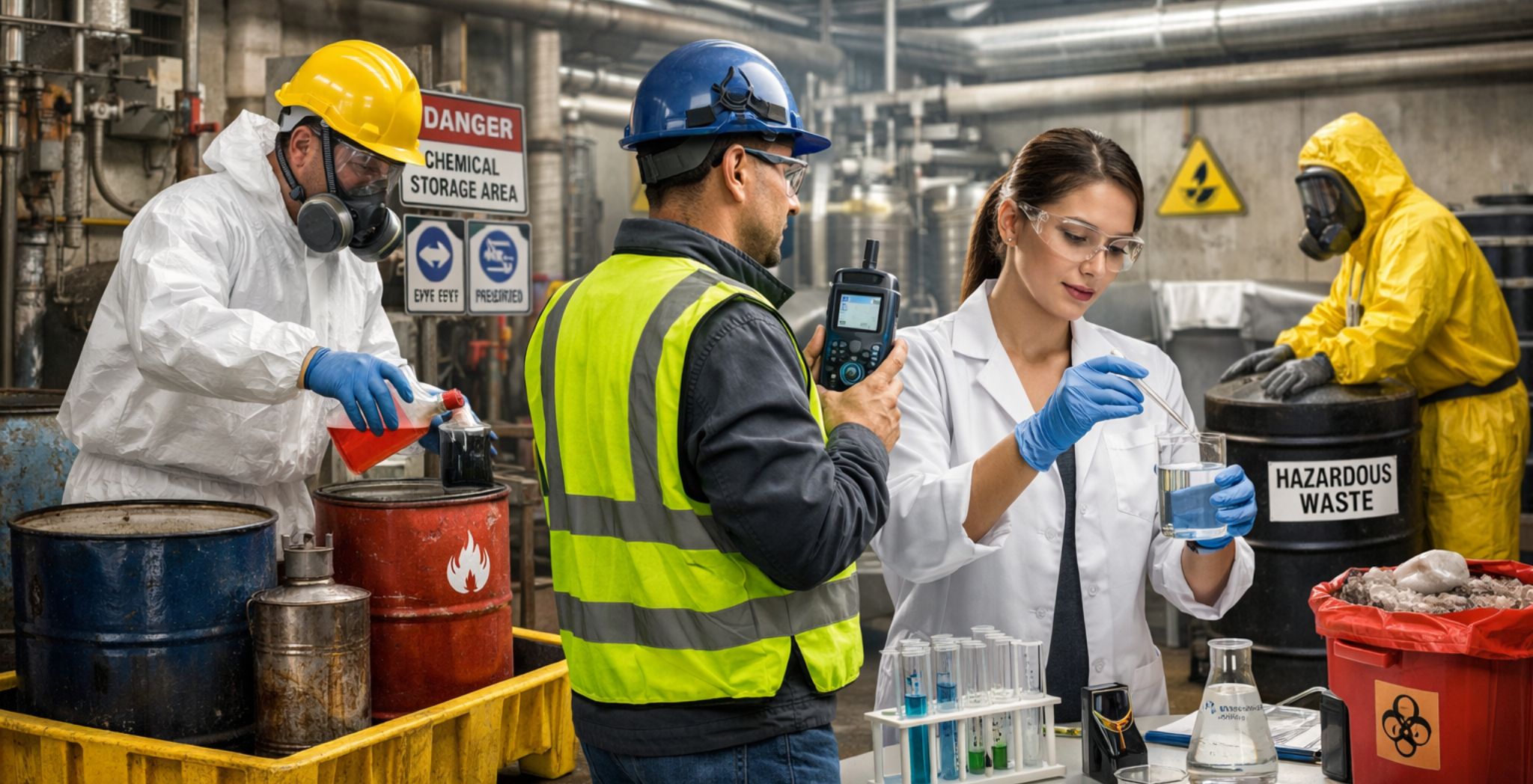
Safety is a culture, not a checklist. Implementing safe waste disposal practices starts with the physical layout of your facility. This includes:
- Secondary Containment: Placing drums on “spill pallets” that can catch leaks.
- Proper Ventilation: Ensuring that fumes from waste storage areas don’t build up.
- PPE (Personal Protective Equipment): Providing employees with the right gloves, goggles, and respirators for the specific chemicals they handle.
- Clear Signage: Marking “Hazardous Waste Accumulation Areas” clearly to prevent unauthorized access.
Navigating Hazardous Material Disposal Challenges
When it’s time to move waste off-site, hazardous material disposal requires coordination with specialized logistics teams. This is not a job for your standard trash pickup service. The vehicles must be placarded according to Department of Transportation (DOT) standards, and drivers must have specific endorsements on their licenses. Furthermore, the facility must ensure that the waste is packaged in “UN-rated” containers that are tested to withstand the vibrations and temperature shifts of over-the-road transport.
How Professional Hazardous Waste Disposal Services Reduce Risk
For most businesses, the complexity of these regulations is too much to handle in-house. This is where hazardous waste disposal services become invaluable. A professional partner provides several layers of protection:
- Expertise: They stay up-to-date on ever-changing state and federal laws.
- Liability Reduction: By ensuring every manifest is signed and every drum is labeled correctly, they protect you from legal blowback.
- Efficiency: They have the equipment to handle “lab packing” and bulk liquid pumping that standard staff cannot do safely.
- Documentation: They provide the “Certificate of Disposal,” which is your final proof that the waste was handled legally.
Conclusion
Hazardous waste disposal is a complex but manageable part of running a successful facility. By focusing on rigorous identification, strict compliance, and a culture of safety, you can protect your employees, your community, and your company’s reputation.
Remember, the cheapest way to handle hazardous waste is to handle it correctly the first time. Mistakes in this field are costly, but with the right practices and professional support from Health System Sciences LLC, you can turn a potential liability into a streamlined, compliant part of your operations. Whether you are dealing with a small laboratory or a massive manufacturing plant, the principles remain the same: respect the chemicals, follow the law, and never cut corners on safety.







Leave A Comment